Movies from Greece
|
Comme des lions de pierre à l'entrée de la nuit (2012) Between 1947 and 1951, the Greek government interned around 80,000 soldiers and civilians (men, women and children) for ‘communist activity.’ They were forced to go through ‘re-education programmes’ in order that they might get back ‘on the right track’ guided by the ideology of the extreme right-wing nationalist King Paul. |
|
|
L'éternité et un jour - Mia aioniotita kai mia mera (1998) Eternity And A Day traces the final days of Alexandre (Bruno Ganz), a celebrated Greek writer as he prepares to leave his seaside home forever. While packing, he finds a letter from his long-dead wife, Anna (Isabelle Renauld), who wrote about an enchanted summer day they spent thirty years ago. From that point, Alexandre embarks on a mystical journey through his past and present. Realizing that after spending his entire life chasing after the words (...) |
|
To vlemma tou Odyssea (1995) A Greek-American filmmaker, known simply as «A», returns to his hometown in northern Greece for a screening of his latest controversial film. His real reason for coming back, however, is to track down three long-missing reels of film by Greece's pioneering Manakia brothers who in the early years of cinema traveled through the Balkans, ignoring national and ethnic strife and recording ordinary people, especially craftsmen, on film. Their images, he believes, hold the key to lost innocence and essential truth, to an understanding of Balkan history Thus he embarks on a search that takes him across the war-torn Balkans, a landscape of spectral figures and broken dreams, right to the heart of darkness: a damaged film archive in Sarajevo where his quest ends. |
|
Le pas suspendu de la cigogne (1991) |
|
Topio stin omichli (1988) LANDSCAPE IN THE MIST is a film about the void. It is a film about despair, about the failure of contemporary society. The prodigal father who figures in almost every Angelopoulos film here has evaporated into his mythical essence - leaving his children to become the wanderers in search of him. In the «chaos», two children appear, little Alexandros and his older sister Voula. In order to exorcise their loneliness, they invent a secret universe for themselves, inhabited by their dreams. |
|
O melissokomos (1986) In THE BEEKEEPER, alienation and despair have so mestastasized in the film's central figure that he's virtually one of the walking dead. Spyros, a man soured by a secret, incestuous love for his daughter, on the day of her wedding, gives up his position as a schoolteacher, his wife, his home and his city to take up again the profession of his father and grandfather before him traveling across Greece to the town in which he was born and first learned to tend the bees, following the traditional beekeeper's route, looking for flowers that will produce the best honey, a wanderer obsessed by his job. |
|
Taxidi sta Kythira - Voyage to Cythera (1984) Cythera, in Greek mythology, is the isle of dreams where one can dedicate oneself to happiness (or the pursuit thereof). In this quest within a quest, the tale of the father's return is told as if from the point of view of his son Telemachus and as if Telemachus were a filmmaker, as well as a middle-aged man with a son of his own. A film director, tired of the illusions and fictions of his profession, searches for a story of substance by attaching himself to an old man, a recently returned political exile. |
|
Athina, epistrofi stin Akropoli - Athen (1983) Angelopoulos was born and grew up in Athens. The Athens that starts from the Acropolis and extends to the small Byzantine churches of the old quarter, the remains of the neo-classical homes, the quiet squares, the apartment buildings, the narrow streets, the vehicles, the pedestrians. It is not a city but the stage on which a drama is being played out, as, of course, is the rest of Greece in the films of Angelopoulos. More specifically, a tragedy made up of treasured memories, stories and personal experience. |
|
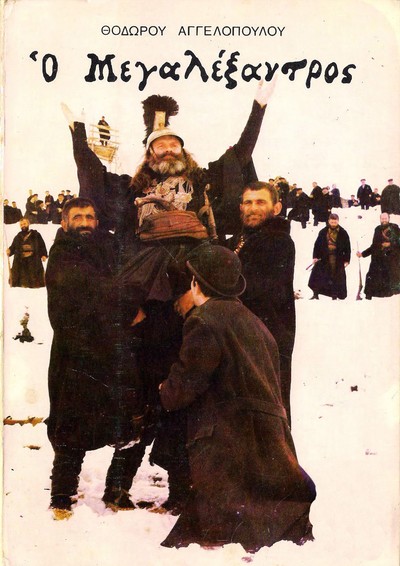
O Megalexandros (1980) The film is a study of the 20th century cult of personality - the myth, the lure and the corruption of the political hero who is a fusion of two characters. Drawing from the so-called Dilessi incident of 1870 (updated in the film to the dawn of the twentieth century), this Megalexandros is a bandit of the sort that typically plagued nineteenth century Greece. Wrapped in the spiritual cloak of yet another Megalexandros - a legendary Greek liberator and King Arthur-like figure whose tale originated in 1453 under Turkish domination and has come down through oral tradition over the centuries - he becomes a leader of mysterious charisma. |
|
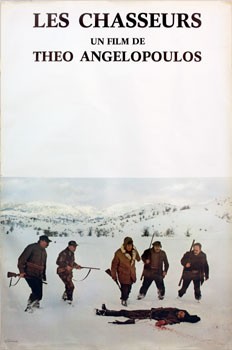
I kynighi - Oi Kynigoi (1977) It is New Year's Eve. 1976. On a Greek island a party of bourgeois hunters comes upon a body, buried in the snow and miraculously preserved by the cold. By his uniform, he appears to be one of the thousands of partisans killed during the civil war and the hunting party, a group of the ruling elite, must now decide what to do with the body. When they disinter it, blood begins to flow from the wounds in the partisan's body and they carry it back to the lodge where the inquest begins. |
|
O Thiasos - O Thiassos (1975) THE TRAVELLING PLAYERS is a film of epic proportions. The action takes place during the years 1939-52 and is seen as a series of individual, often inexplicable events or tableaux, commentated by monologues, by slogans written on the walls, or by songs. It reveals the period's turbulent history while focusing on a travelling company of actors who spend those fourteen years wandering through provinces, cities and villages, performing, in increasingly threadbare circumstances, a 19th century pastoral melodrama, Persiadis' Golfo the Shepherdess. |
|
Meres tou 36 (1973) A trade unionist is assassinated at a workers' rally and a former police informer, Sofianos, is arrested and charged with the murder. The accused, a greatly troubled personage, currently out on probation, an ex drug-trafficker is being used to infiltrate and bring down his old accomplices. He is visited in prison by a Conservative Member of Parliament with whom he has a homosexual relationship. Using a smuggled gun, the prisoner takes the politician hostage creating an embarrassing and increasingly absurd scandal for the authorities. |
|
Anaparastasi - Αναπαράσταση (1970) The film is based on an actual event, the murder of a Greek worker living in Germany by his barmaid wife Eleni and her lover Christos, who falsify the evidence of the husband's return to Germany but are suspected by a sister-in-law and eventually accuse each other of the crime. A woman murders her husband, upon his return home after a long absence, with the complicity of the lover who has relieved her loneliness. Costas Ghoussis, an emigrant recently returned to his native country, is coming back from the fields, a shovel on his shoulder. |